
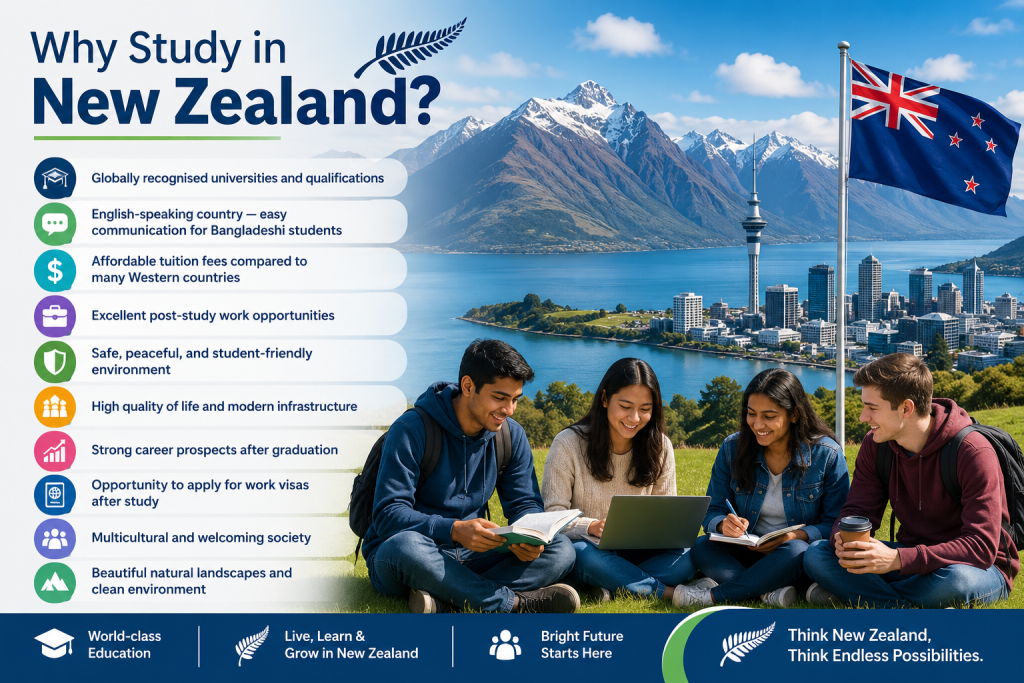
New Zealand has become one of the most attractive study abroad destinations for Bangladeshi students due to its world-class education system, globally recognised universities, peaceful environment, and excellent post-study work opportunities. Known for its high quality of life and welcoming multicultural society, New Zealand offers international students a perfect balance between academic excellence and lifestyle.

| University | City | World Ranking (QS) | Known For |
|---|---|---|---|
| University of Auckland | Auckland | Top 100 | Engineering, Business, Medicine |
| University of Otago | Dunedin | Top 250 | Health Sciences, Medicine |
| Victoria University of Wellington | Wellington | Top 250 | Law, Humanities, IT |
| University of Canterbury | Christchurch | Top 300 | Engineering, Science |
| Massey University | Palmerston North | Top 300 | Aviation, Agriculture, Business |
| University of Waikato | Hamilton | Top 350 | Computer Science, Education |
| Lincoln University | Lincoln | Top 400 | Agriculture, Environmental Science |
| Auckland University of Technology (AUT) | Auckland | Top 500 | Technology, Hospitality, Design |
| Expense | Estimated Cost (Per Year) | Notes |
|---|---|---|
| Tuition Fees | NZD 20,000 – 40,000 | Depends on course and university |
| Living Costs | NZD 15,000 – 22,000 | Accommodation, food, transport |
| Health Insurance | NZD 500 – 800 | Mandatory for international students |
| Total Estimated Cost | NZD 35,000 – 60,000 | Approximately BDT 25 – 43 lakh |
While New Zealand is more expensive than many Asian countries, it remains more affordable than studying in the USA or UK.
International students from Bangladesh can apply for various scholarships.
Scholarships may partially or fully cover:
Students with strong academic results have higher chances of receiving scholarships.
To study in New Zealand, students need a valid Student Visa.
Most institutions require English language proficiency.
Some universities may accept alternatives such as PTE or TOEFL.
International students are allowed to work while studying.
Part-time jobs help students manage living expenses and gain work experience.
One of the biggest advantages of studying in New Zealand is the post-study work pathway.
Graduates may apply for post-study work visas, allowing them to gain professional experience after graduation.
Skilled graduates may later explore long-term residency opportunities depending on immigration policies.
New Zealand universities follow British-style education systems and maintain excellent academic standards.
New Zealand consistently ranks among the safest countries globally with low crime rates and friendly communities.
Students can gain international work experience during and after their studies.
As an English-speaking country, Bangladeshi students can easily adapt academically and socially.
New Zealand offers a clean environment, beautiful scenery, and relaxed lifestyle that many international students enjoy.
Find quick answers to common queries about our consultancy services.
Yes. New Zealand qualifications are globally recognised and respected by employers and universities worldwide.
Yes. International students can work up to 20 hours per week during study periods and full-time during holidays.
In most cases, yes. IELTS or another approved English language test is generally required.
New Zealand is moderately expensive, but still often more affordable than studying in the USA or UK.
Yes. New Zealand is considered one of the safest and most peaceful countries in the world.